Why a Living Trust Matters More Here Than Almost Anywhere Else
San Luis Obispo County home values have climbed steadily for more than a decade. A modest house near downtown SLO now easily clears $900,000. Coastal properties in Morro Bay, Pismo Beach, and Avila Beach routinely exceed $1.2 million. That matters for estate planning because California probate is calculated on the gross value of your estate, not your equity. A home with a $600,000 mortgage and a $1 million market value is a $1 million probate estate.
While we are rooted in the Central Coast, we serve estate planning clients throughout California. Trust law, probate avoidance, Prop 19 planning, and the statutory fee structure under the California Probate Code apply statewide. Clients in the Bay Area, Los Angeles, Sacramento, San Diego, and across California retain us for living trust packages, Prop 19 analysis, and probate matters. Most of our out-of-area work is completed entirely by phone, video, and secure document delivery. If you are a California resident with real property in the state, we can help you regardless of where you are located.
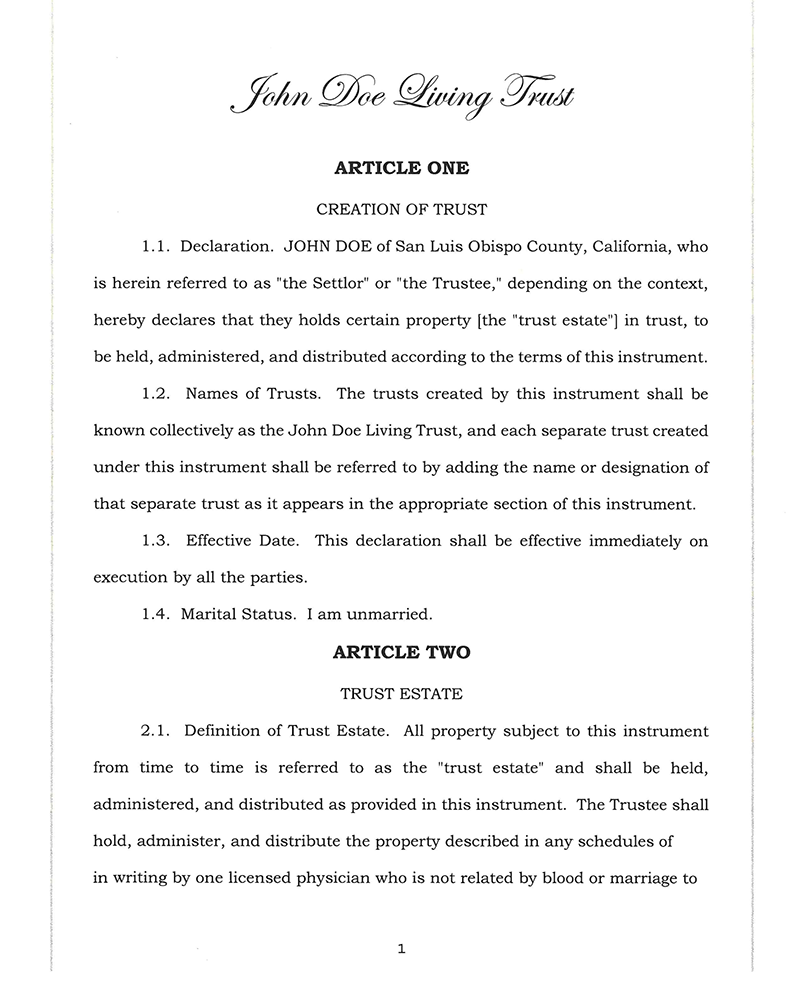
Under California Probate Code sections 10810 through 10814, combined statutory attorney and executor fees on a $1 million estate exceed $46,000. Add court costs, filing fees, probate referee appraisals, and the process easily runs $50,000 to $60,000 before distribution. It also takes 12 to 18 months minimum, during which the property is frozen. A properly funded revocable living trust avoids every bit of that.
At Tardiff & Saldo, we have both drafted estate plans and argued them in court. That dual perspective is uncommon, and it directly shapes every document we create. We know which provisions hold up under pressure because we have been on both sides of these cases in San Luis Obispo County Superior Court.
What a Complete Estate Plan from Tardiff & Saldo Includes
We structure every estate plan as an integrated package. The following documents work together as a system, and we do not deliver them piecemeal.
Blended Family, Two Properties, One Clear Plan
The Situation
A Paso Robles couple came to us with a blended family of four adult children from two prior marriages. They owned a home near Templeton and a rental property on the coast near Cayucos. No trust, only a 12-year-old will that named an ex-spouse in one section. Their combined estate exceeded $1.6 million in gross value.
Our Approach
We created a joint revocable living trust with separate property schedules to track each spouse's assets. We re-deeded both properties into the trust using Prop 19-compliant transfers to preserve the parent-child exclusion. We drafted co-trustee provisions that prevented either adult child faction from controlling the trust unilaterally during the surviving spouse's lifetime. The pour-over will, DPOA, and healthcare directive completed the package.
The Outcome
Both deeds recorded within 10 days of signing. The surviving spouse now controls the full trust without court involvement. No probate exposure on either property. The blended family provisions eliminated the ambiguity that had existed for years.
Client name changed. Results vary based on individual circumstances.
How Our Estate Planning Process Works
We offer flat-fee estate planning packages with transparent pricing discussed during your free consultation. Payment plans are available. The process is straightforward and typically complete within two to three weeks of your first meeting.
We start with a free consultation of 30 to 45 minutes by phone or in person, where we assess your assets, family structure, and goals. We then prepare a full draft package and review it with you in a second meeting before coordinating signing with proper notarization. We handle deed transfers and trust funding as part of every plan so you leave with a fully funded, working trust, not just documents.
Prop 19 and SLO County Property Owners
California's Proposition 19, effective February 2021, significantly changed how property transfers between parents and children are taxed. Under Prop 19, the parent-child exclusion from property tax reassessment is now limited to a home the child actually uses as a primary residence, capped at $1 million over assessed value. Transfers to adult children who rent the property or let it sit will trigger full reassessment at current market values, which can mean dramatically higher property taxes on appreciated Central Coast real estate.
Proper trust planning can affect how these transfers are structured and, in some cases, can reduce exposure. We cannot guarantee tax outcomes, and Prop 19 analysis requires reviewing your specific property values and family circumstances. We raise these issues in every estate plan review for property owners because the stakes are significant. See the California Board of Equalization guidance on Prop 19 for the governing rules.
When You Should Update Your Existing Trust
An estate plan is not a one-time document. You should review yours after any of the following: marriage or divorce, birth or death of a beneficiary, purchase or sale of real property, significant change in asset values, a beneficiary develops a disability or substance dependency, or after any major change in California law. We regularly see clients with trusts drafted in the 1990s and early 2000s that contain provisions no longer valid under current law. A plan review is a flat-fee service. We also work with clients whose family member is now handling probate because no trust was ever created.
We serve clients throughout SLO County, including Paso Robles, Arroyo Grande, Atascadero, and Morro Bay. The California Probate Code governs all of this, and the California State Bar publishes useful public guidance on the probate process.
Watch: Why a living trust beats a will alone for SLO County property owners.